
ARCHEOASTRONOMIA LIGUSTICA
Pubblicato
in: Cielo e Terra: fisica e astronomia,
un antico legame. Saggi di storia della fisica e dell’astronomia e
dell’archeoastronomia. Aracne Editrice, Ariccia
(RM), giugno 2014, pp. 323-339, ISBN 978-88-548-7206-6.
THE
KNOWLEDGE OF THE AEQUINOCTIAL PRECESSION BEFORE HYPPARCUS
Mario Codebò
1) Riassunto
In questo lavoro si esaminano sei
indizi che depongono per una conoscenza della precessione degli equinozi prima
di Ipparco (II secolo a. C.):
1 la coppa Foroughi (prima
metà del I millennio a. C.), che riproduce una configurazione zodiacale del
IV-III millennio a. C.;
2 il frammento 4Q318 di
Qumran, detto "Brontologion" che presenta un calendario zodiacale in
cui il primo ed il secondo giorno del primo mese - I-II Nisan - sono posti
sotto il segno del Toro;
3 la data biblica della
creazione (circa 4000 a. C. nella versione ebraica e circa 5500 in quella
greca) risalente all'epoca in cui l'equinozio vernale stava entrando in Toro;
4 alcune altre date di
eventi biblici salienti (diluvio, nascita di Abramo e sua migrazione in
Palestina, nascita di Mosè ed Esodo) che sembrano essere scandite dagli
spostamenti sullo zodiaco dei punti equinoziali;
5 due zodiaci babilonesi in
cui la successione dei segni è quella consueta ma quello da cui inizia la
sequenza è, rispettivamente, il Leone e la Vergine;
6 alcuni simboli del dio
Mithra (il toro, il leone, la brocca ed il serpente) che paiono rispecchiare le
configurazioni tropicali del IV-III millennio a. C. quando gli equinozi di
primavera e d'autunno erano, rispettivamente, nel Toro e nello Scorpione ed i
solstizi d'estate e d'inverno rispettivamente nel Leone e nell'Acquario,
considerando che la brocca ben rappresenta quest'ultimo e che il serpente può
ben rappresentare l'Ophiucus. In ogni caso, uno scorpione compare in molte
raffigurazioni di Mithra, il quale, essendo già presente nell'Avesta (la cui
composizione si fa risalire a non dopo il X-IX secolo a. C.) come ipòstasi di
Ahura Mazda, pare proprio risalire alla religione aria politeista
pre-zoroastriana.
Tutti questi indizi mostrano che le
civiltà ebraica e mesopotamica sapevano che nel IV-III millennio i punti
equinoziali e solstiziali si trovavano in costellazioni diverse da quelle del
II-I millennio. Particolare enfasi sembra fosse data alla presenza del punto
vernale in Toro.
Si mostra poi come l'errore di misura
della velocità precessionale sia da attribuire non ad Ipparco ma a Tolomeo, il
quale pare avere commesso anche altri errori. Si propone in conclusione la tesi
che la precessione degli equinozi fosse ben nota, probabilmente nel mondo
mesopotamico da cui gli Ebrei avrebbero attinto, assai prima di Ipparco e che a
quest'ultimo sia stata attribuita la scoperta per una serie di errori di
Tolomeo.
2) Preface
It
is a common idea that Hypparcus discovered the aequinoctial precession in the
2nd century b. C. and that it was unknown before him. But we have some
evidences that it was known some millennia ago. Many authors are convinced
about it by now. In this paper I will debate five evidences about the knowledge
of the aequinoctial precession before Hipparcus and besides I will show as
Hypparcus's ideas were probably distorted by Ptolemy.
2.1) The Foroughi cup
It
was debated already by Maria Giulia Amadasi Guzzi and Vittorio Castellani (†)
(Amadasi & Castellani 2005; 2006), therefore I shall limit myself to
expound their conclusions.
The
bronze-made Foroughi cup was built during the first half of the first
millennium b. C. by Aramaic masters. It reproduces a starry sky with some
recognizable constellations and heavenly bodies. Its origin and its age are
provided by seven engraved inscriptions typical of Aramaic culture VIII-VII
century b. C..
About
the several heavenly constellations and stars groups (Ursa Major and Minor,
Pleiades, Corona Borealis, a Man With A Stick In His Right Hand, a Monkey, some
comets and some rayed stars, the Moon, the Sun and perhaps the visible
planets), the interesting ones for our purpose are the four ones put at the
tips of a cross, two of them clearly reproducing Taurus and Leo; the third one
seeming to be the Scorpio and the fourth one can no more be identified because
of another engraving upon it.
The
fact that the Leo is in the engraving reproducing the Sun, the Moon is around
the no-more-identifiable-constellation and Taurus and Scorpio are not
associated to any heavenly body, induced the authors to think that Leo and the
no-more-identifiable-constellation symbolizes, respectively, summer and winter
solstices. Maybe consequently that these are the tropical representations of
the summer solstice in Leo and the aequinoxes in Taurus and in Scorpio. If this
is true, the fourth no-more-identifiable-constellation should be Aquarius. But
this is the astronomical situation of the IV-III millennium b. C., while during
the 1st millennium b. C. the four tropical constellations were Aries (spring
aequinox), Cancer (summer solstice), Libra (autumn aequinox) and Capricorn
(winter solstice). Therefore it is right to deduce that the Foroughi Cup does
not show the heavenly situation of the age in which it was made but the
previous one, one or two millennia before when the spring aequinox was in
Taurus, the summer solstice in Leo, the autumn aequinox in Scorpio and the
winter solstice in Aquarius.
The
respective position of the two Bears (Ursa Major and Ursa Minor), at two
opposite sides of the center in the cup, reproduces the polar representation at
the end of the II millenium b.C. when the North Heavenly Pole was in Draco,
between Ursa Major ans Ursa Minor.Therefore the two authors deduce that the
Forughi Cup is "...the first graphic representation of a past heaven in
which the effects of the precession are shown".
2.2) 4Q318 Brontologion
The
Qumran fragment 4Q318 (the acronym means that this fragment is the number 318
and was found into the cave number 4 of Qumran) is called brontologion -
from the two Greek words brontos = thunder and logos = wisdom -
because it teaches how to foretell the future from thunders. But it is an
annual calendar too and it describes to which Zodiacal sign every day of every
month of the year belongs. Therefore, it is an astrological calendar
(R.H.Eisenman and M. Wise 2006).
Just
because 4Q318 was written in 2nd - 1st century b. C., we would expect rightly
that this Zodiac calendar begins with the Aries sign or, more properly,with the
Pisces sign, because the vernal point passed from Aries to Pisces just during
that period: at the end of the 1st century b. C. the Aries age finished and the
Pisces age began (Bianchi and Codebò 2005; Bianchi, Codebò, Veneziano 2005,
2009, c.s.1).
But
surprisingly the 1st and the 2nd days of the 7th month Tishri - i. e. our
September/October - are assigned to Scorpio (4Q318, 1, 9). Although the Nisan
verses are missing, it is possible to restore their meaning using the verses of
Shevat (4Q318, 2, I, 4) and Adar (4Q318, 2, II, 1). Indeed the attribution of
the days to each zodiacal sign goes back:
Shevat
is the 11th month (corresponding to our November/December): its 1st and 2nd
days are assigned to Pisces; 3rd and 4th to Aries and 5th, 6th and 7th to
Taurus (4Q318, 2, I, 4);
Adar
is the 12th month and its 1st and 2nd days are assigned to Aries; 3rd and 4th
to Taurus;
it
follows evidently that the 1st and 2nd days of the 1st month Nisan are assigned
to Taurus.
Therefore,
we have a text of the end of the 1st millennium b.C. which shows a Zodiacal
configuration of the 4th - 3rd millennium b. C.
2.3) the Biblical date of the world Creation
By
the reconstruction of the succession of the generations before a certain date
of a well-known event (i. e. the destruction of Jerusalem by Babilonian army in
587-586 b. C. or Cyrus's Liberation Edict in 538-537 b.C., it is possible to
date the main ancient events of the Old Testament. Of course, this time-reconstruction
does not correspond necessarily to the reality, but it is only a Biblical
chronology.
Many
reconstructions - ancient, for instance, the Anglican Bishop James Ussher's one
(J. Usserius 1722) and modern, for instance, Jehova's Witnesses' one - exist
and closely show a similar chronology. The big difference is between the
Masoretic text and the Greek text.
The
Masoretic Text - and Vulgata Text with it - dates the world Creation around
4000 b. C., while the Greek text dates it around 5500 b. C. The differences are
mainly in the ages of the antediluvian patriarches (list # 1).
List # 1: patriarches’ chronology
according to different sources. The “age” of each patriarch refers the birth of
his first-born
#
|
Name |
TM[1] |
Vulg.[2] |
LXX[3] |
A. J.[4] |
Jub.[5] |
B.J.[6] |
N. D.[7] |
J.W.[8] |
|
01 |
Adam |
0130 |
0130 |
0230 |
0230 |
130 CM[9] |
0130 |
0130 |
0130 |
|
02 |
Seth |
0105 |
0105 |
0205 |
0205 |
229 CM |
0105 |
0105 |
0105 |
|
03 |
Enos |
0090 |
0090 |
0190 |
0190 |
327 CM |
0090 |
0090 |
0090 |
|
04 |
Kenan |
0070 |
0070 |
0170 |
0170 |
396-461
CM |
0070 |
0070 |
0070 |
|
05 |
Mahalaleel |
0065 |
0065 |
0165 |
0165 |
461 CM |
0065 |
0065 |
0065 |
|
06 |
Jared |
0162 |
0162 |
0162 |
0162 |
523 CM |
0162 |
0162 |
0162 |
|
07 |
Enoch |
0065 |
0065 |
0165 |
0165 |
588 CM |
0065 |
0065 |
0065 |
|
08 |
Matusalemme |
0187 |
0187 |
0167 |
0187 |
653 CM |
0187 |
0187 |
0187 |
|
09 |
Lamech |
0182 |
0182 |
0188 |
0188 |
701-708
CM |
0182 |
0182 |
0182 |
|
10 |
Noè |
0500 |
0500 |
0500 |
0500 |
1208 CM |
0500 |
0500 |
0500 |
|
|
1st
subtotal |
1556 |
1556 |
2142 |
2162 |
|
1556 |
1556 |
1556 |
|
|
deluge
|
|
|
|
|
1308
CM? |
|
|
|
|
11 |
Sem |
0100 |
0100 |
0100 |
|
|
0100 |
0100 |
0100 |
|
12 |
Arpaxad |
0035 |
0035 |
0135 |
0135 |
1376 CM |
0035 |
0035 |
0035 |
|
13 |
Kainan |
|
|
0130 |
|
1433 CM |
|
|
|
|
14 |
Selach |
0030 |
0030 |
0130 |
0130 |
1455 CM |
0030 |
0030 |
0030 |
|
15 |
Eber |
0034 |
0034 |
0134 |
0134 |
1567 CM |
0034 |
0034 |
0034 |
|
16 |
Peleg |
0030 |
0030 |
0130 |
0130 |
1580 CM |
0030 |
0030 |
0030 |
|
|
Babel tower |
|
|
|
|
1638 CM |
|
|
|
|
17 |
Reu |
0032 |
0032 |
0132 |
0130 |
1687 CM |
0032 |
0032 |
0032 |
|
18 |
Serug |
0030 |
0030 |
0130 |
0132 |
1793 CM |
0030 |
0030 |
0030 |
|
19 |
Nakor |
0029 |
0029 |
0079 |
0120 |
1806-1813
CM |
0029 |
0029 |
0029 |
|
20 |
Thera |
0070 |
0070 |
0070 |
0070 |
1876 CM |
0070 |
0070 |
0070 |
|
|
Abraham’s birth |
|
|
|
|
1876 CM |
|
|
|
|
|
2nd subtotal |
0390 |
0390 |
1170 |
1081 |
|
0390 |
0390 |
0390 |
|
|
Total
|
1946 |
1946 |
3312 |
3243 |
|
1946 |
1946 |
1946 |
|
|
Differences |
|
|
+1366 |
+1298 |
-70 -1436 -1367 |
|
|
|
|
|
Abraham |
0100 |
0100 |
0100 |
|
|
0100 |
0100 |
0100 |
|
|
Isaac |
0060 |
0060 |
0060 |
|
|
0060 |
0060 |
0060 |
|
|
Jacob |
0130 |
0130 |
0130 |
|
|
0130 |
0130 |
0130 |
The
first known Jewish ancient reconstruction of the age of Creation was written in
Seder Olam Rabbah, II century A.D. aged (Encyclopaedia Judaica 1971-1972). According
to it, the world was created 3828 years before the destruction of the second
Jerusalem temple, i.e. 3761 b. C. But Seder Olam Rabbah includes two errors: it
dates back the Roman destruction of the second Jerusalem temple to 68 A.D. and
compressed the length of the Persian rule to thirtyfour years! But, as a matter
of fact, Romans destroyed the second temple of Jerusalem in 70 A.D. and the
Persian rule lasted from the conquest of Babylon in 539 b. C. by Cyrus to the
Gaugamela battle, when Alexander the Great destroyed the Persian Empire in 331
b. C., i.e. two-hundred-eight years. Therefore, the Seder Olam Rabbah date of
the world creation must be back-dated 2 + 208 = 210 years: i.e. 3761 + 210 =
3971 b. C., in accordance with the date calculated by J. Ussher, Jehova's
Witnesses and some Fathers of the Church: about 4000 b. C.! It is intersting
that St. Augustin "reproached" St. Jerome because he put forward, in
his Vulgata, the world creation date to 4000 b. C., instead of 5500 b. C., i.
e. after the translation of the Old Testament directly from the Jewish Text
instead from the Greek Text.
Why
does Old Testament date the age of the world creation about 4000 b. C.?
My
hypothesis is that at the end of the 5th millennium b. C. it happened the same
astronomical configuration of the 6 b. C., when the whole Mediterranean world
was waiting for the beginninig of a new age (Bianchi and Codebò 2005; Bianchi,
Codebò, Veneziano 2005, 2009, c.s.1) and the Jews particularly were waiting for
their Messiah: the threefold conjunction (technically: the smallest angular
separation) of Jupiter and Saturn just in the constellation in which the Vernal
Point Y was entering beginning a new zodiacal age. In 6 b. C. this
constellation was Pisces and in 4000 b. C. was Taurus. Considering the
"form" of Taurus constellation, the entry of Vernal Point in Taurus
dated 4059 b.C., when Beta Tauri, Vernal Point and Zeta Tauri were in straight
line, while considering the "first" star of Taurus according to the
Ptolemy's Star Catalogue(which is our oldest star catalogue), i.e. 139Tauri,
Vernal Point entry was in 4438 b. C., when right ascension of 139 Tauri was 0°00'00".
We are trying to calculate the true year in which the threefold conjunction J/S
took place, because different algorythms and softwares give different results:
Skyglobe
36 give 4097 b. C.;
Planetario
2.0 gives 4098 b. C.
Solex
9.1 gives 4336 b. C. (the only one threefold conjunction J/S from 4500 b. C. to
4000 b. C.) but in Aries and none in Taurus;
VSOP87
gives 4217 b. C. between Taurus and Aries and 4038 b. C. between Taurus and
Gemini.
The
question of the true date of the threefold conjunction J/S in Taurus will be
the subject of a next paper. For the present, it is enough for us to note that
the difference of 4000 years between the two threefold conjunction J/S in the
constellation in which the Vernal Point was entering is about the same amount of
time between the world creation and the time of the destructionof the second
Jerusalem temple. It seems, I think, that Biblical writers would use this
precessional time period like a calendar of the Holy Tales. But this
demonstrates that the precessional phenomena were known before Hypparcus.
Note
that the date of the world creation in Greek biblical version LXX - i. e. 5500
b. C. - corresponds with the speed of the aequinoctial precession according to
Ptolemy: 1° per century, i.e. 36" per annum, while the Jewish date 4000 b.
C. corresponds to the true speed of the aequinoctial precession 50,29" per
annum.
It
may be that Jews learnt the true speed and time of the precessional movements
from Babylonians, perhaps during their captivity in Babylon during the 6th
century, or that they knew them indipendently. At present, we have not enough
data to realize which is the true one between the two hypotheses, but it is
clear enough that precessional phenomena, times and speed had been well known
since the written composition of the biblical textes, i. e. almost since the
half of 1st millennium b. C., three hundred and fifty years before Hypparcus
and probably remembering the heavenly tropical configuratios of 4th-3rd
millenniab. C. by means of verbal traditions.
2.4) The date of the main biblical events
E.
Bianchi suggested to detect if the main events of the Torah were connected with
the
aequinoctial
precession. Some results of my research are collected in list # 2
List # 2: Biblical chronology and aequinoctial precession
|
4000 a.C. about: world creation |
4439 b.C. α Tauri R.A. 0h00m00s: Vernal
Aequinox goes into Taurus |
|
|
4336 b. C. the threefolder conjunction in Aries
according to Solex 9.1 |
|
|
4217 b. C. . the threefolder conjunction in
Taurus-Aries according to VSOP87 theory[10] |
|
|
4098 b.C. the threefolder conjunction according to
Planetario 2.0 and Skyglobe (4097 b. C.) |
|
|
4036 b.C. the threefolder conjunction in
Gemini-Taurus according to VSOP87 theory[11] |
|
|
3947 b.C. G Scorpii R.A. 12h00m00s: Autumnal Aequinox
goes into Scorpio |
|
2370 b.C.: the Deluge according to the Jehova’s
Witnesses 2017
according to E. Bianchi |
2317 b.C. τ Librae, Autumnal Aequinox and
θ Librae in straight line: Autumnal Aequinox goes into Librae |
|
|
2305 b.C. ρ Scorpii R.A. 0°00’00”: Autumnal
Aequinox goes out from Scorpio |
|
|
2220 b.C. η Tauri R.A. 0°00’00” |
|
2018 the birth of Abraham according to the Jehova’s
Witnesses 2017
according to E. Bianchi |
2163 b.C. η Tauri, Vernal Point and ο Tauri
in straight line: Vernal Point goes out from the “figure” of Taurus |
|
|
2003 b.C. ο Tauri R.A. 0°00’00”: Vernal Point goes
out from Taurus |
|
1943 b.C. Abraham vocation according to Jehova’s
Witnesses |
1816 b.C. τ Arietis 0°00’00”: Vernal
Point goes into Aries |
|
1593 b.C. the Exodus according to the Jehova’s
Witnesses 1592
according to E. Bianchi |
1621 b.C. δ Arietis R.A. 0°00’00”: Vernal Point
goes into the “figure” of Aries |
To
calculate each astronomical event I used the aequatorial coordinates R.A. and
D., the FK4 system, Smithsonian Astronomical Observatory star data 1950, and
the Newcomb's algorithms according to J.Meeus 1990 pp. 61-73.
Because
we do not know exactly the boundaries of the ancient constellations, I
calculated:
1)
the year in which the first and/or the last star of the appropriate Zodiacal
constellation reached R.A. 0°00'00". I mean "first and/or last"
star according to the Ptolemy's Alamgest Star Catalogue (Taliaferro 1980),
which is the oldest one we have. Please note that Ptolemy divided the stars of
each constellation into "formatae" (which means: forming the
constellation figure) and "informatae" (which means: out the figure
but inside boundaries of the constellations).
2)
every time it is possible, the year in which the Vernal Point was in straight
line with the first or last two stars of each zodiacal constellation.
I did not tranform aequatorial into eccliptical coordinates: this calculation and some other arguments will be discussed in a further paper.
Tab
n. 2 shows that:
1)
as written in previous § 3, the biblical date of the world creation - about
4000 b. C. - coincides with the entry of the Vernal Point in Taurus;
2)
the biblical date of the Deluge coincides with the passing of the Autumnal
Point from Scorpio to Libra;
3)
the biblical date of Abraham birth coincides with the passing of Vernal Point
from Taurus to Aries;
4)
the biblical date of Moses birth coincides with the entry of Vernal Point in
the figure of Aries. All the deeds of Israelite People - since Abraham to
Maccabees - took place in Aries Age.
5)
Maccabees' rebellion - like many other ones of the 2nd century b. C. in all the
Mediterranean basin (Bianchi, Codebò, Veneziano 2005; Bianchi, Codebò 2005) -
took place when the Vernal Point leaves Aries and set out for Pisces, giving
hope of a new age of peace and liberty. Some outstanding examples of these
hopes were the rebellion of the Heliopolitans in Pergamum (half of 2nd century
b. C.), whose name means Sun Citizens, and the Roman Servile Wars (1st century
b.C.). The end of these hopes coincided with the two Jewish Wars (66-70 and
133-135 A.D.).
2.5) Two Babylonian zodiacs
G.
Pettinato (Pettinato 1998, pp. 113-115) relates about two Babylonian lists of
zodiacal
constellations
which were written in the 1st millennium b. C., including the twelve zodiacal
constellation listed according to the usual sequence and not starting with
Aries but with Leo (the one) and Virgo (the other). He writes that he cannot
understand the reason of this anomalous beginning. It is possible and
reasonable to guess that these two "zodiacs" are the witness of very
old traditions when the Vernal Point - i. e. the beginning of Spring - was in
Leo (10th and 9th millennia b. C.) and in Virgo (12th and 11th millennia b.
C.): they might be witnesses of prehystoric traditions verbally transmitted
across hundreds of generations.
It
is interesting to consider that, according to the Avestic teology, Ahura Mazda
created the world for a cycle of 12000 years and that at end of this cycle,
during which the Evil (whose name is Angra Mainyu) would become stronger and
stronger - a Saosyant (which means Saviour) will bear and lead the
people of Ahura Mazda across the final judgement. In a previous paper of us, we
maintained that the Magi travelled to Betlehem not looking for the Jewish Messiah
but for the Mazdaic Saosyant and that one of the marks of Saosyant's birth was
the entry of the Autumnal Point in Virgo just at the end of the 1st millennium
b. C., precisely on 15 b. C. - another one being the threefold conjunction J/S
in the same constellation in which the Aequinoctial Points were entering, i.e.
into Pisces - (Bianchi, Codebò, Veneziano 2005): 12000 years before the age of
Magi the Vernal Point was in Virgo. Therefore I suggest that the cycle of the
Ahura Mazda's creation is pucntuated by the shifting of aequinoctial points
from Virgo to Virgo on half precessional period.
The
name of Spica (Alfa Virginis) may derive from the position of Summer Solstice
in Virgo during the 6th and 5th millennia b. C., just when agriculture spread
over the Old Continent.
2.6) Mithras's symbols
As
everybody knows, the kernel of the mithes of Mithras is the killing of the
bull. But there are many other symbols in his mithology, often represented in
his monuments too.
Among
these symbols the Bull, the Lion, the Jug, the Snake may have an astronomical
meaning: if we identify the Jug with Aquarius and the Snake with Ophiucus,
which is near Scorpio, we get the four tropical constellations of 4th and 3rd
millennia b. C.
In
Avesta, the Holy Book of Zoroasterian religion, is a yazata, the spirits
faithful to the sole god Ahura Mazda. As Zoroaster, according to the opinion of
contemporary experts, lived during the 9th - 8th century b. C. or even during
the second half of the 2nd millennium b. C. (Alberti 2004) and reformed the
ancient polytheistical Aryan religion in a monotheistic way transforming the
old polytheistic gods into spirits subordinate to the sole god Ahura Mazda, we
can assume Mithra was originally a god of the ancient Aryan pantheon - perhaps
the god of the sun - and that these four symbols stood for the tropical
positions of Mithra/Sun during this polytheistic period foregoing Zoroaster's
reform.
3) Hypparcus, Ptolemy and the Almagest
It
is a widespread conviction that Hypparcus calculated the speed of the
aequinoctial precession to be 1° per century, i.e. 36" per year, but a
careful reading Ptolemy's Almagest, chapter 7th, § 2, expecially in old Greek
(Heiberg 1903), shows that this is not true.
Hypparcus's
books are lost and his thought was transmitted to us by Ptolemy in his
Almagest. In chapter 7th, § 2, whose title is "That the sphere of the
fixed stars makes a movement eastward on the ecliptic", Ptolemy, debating
about the aequinoctial precession, quotes a sentence from Hypparcus's lost book
On the magnitude of solar year: <If for this cause the tropics and
equinoxes shifted westerward not less than 1/100° in a year, than they would
have to shift not less than 3° in 300 years> (Taliaferro 1980, p. 227). The
original Greek sentence is: <Ει̉ γὰρ
παρὰ ταύτην
τὴν αι̉τίαν
αί τε τροπαὶ
καὶ ι̉σεμηρίαι
μετέβαινον
ει̉ς τὰ
προηγούμενα τω̃ν
ζω̣δίων ε̉ν
τω̣̃
ε̉νιαυτω̣̃ μὴ
ελασσον
η
εκατοστον
μιας μοιρας,
εδει
ε̉ν τοι̃ς
τριακοσίοις ετεσιν
μη
ελασσον
η
γ¯ μοίρας αυτα
μεταβεβηκεναι>[12]. The
same sentence (picture 1) in Latin is: <Si enim - inquit - propter hanc
causam solstitia & aequinoctia ad precedentia signorum non minus per annum
quam centesimam unius gradus partem mouerent. In 300 certe
annis non minus quam per tres gradus transgressa fuissent>
(Ptolemaeus 1528).
The
meaning of the sentence is clear: Hypparcus does not says that the speed of the
aequinoctial precession is 1° per century, but that it is not less than
1° per century, which may mean that it is more than 1° per century, as
it is in reality.
The
conclusion that the speed of the aequinoctial precession is 1° per century is
by Ptolemy which, few lines above, writes: <And so from this it is found
that there is an eastward shift of 1° in very nearly 100 years, as Hypparcus
seems to have guessed when he says his treatise On the Magnitude of the
Solar Year: <If for this cause the tropics and equinoxes shifted
westerward not less than 1/100° in a year, than they would [sic!] have to shift
not less than 3° in 300 years> (Taliaferro 1980, p. 227).
Therefore,
Ptolemy distorted Hypparcus's thought and this is not his only mistake. Otto
Neugebauer had already noticed (Neugebauer 1974, p. 232), that according to Ptolemy's
theory, the Moon apparent diameter must change of about half size; that does
not happen. Neugebauer concludes that it was impossible that Ptolemy did not
realize this inconsistency and that his model was kept only because it allowed
<...to forecast properly the longitudes at least>.
More
recently, in one of his papers issued on Archive for History of Exact
Sciences astronomer Dennis Duke says that using the Almagest position data
of Mars, Jupiter and Saturn and Ptolemy's algorithms one gets new positions of
these three planets which are very different from the new ones of the Almagest.
And because Ptolemy was an expert mathematician, Dukes comes to the conclusion
that Ptolemy "forced" results and theory by his authority (Codegoni
2004, p. 117). Which is about the same conclusion of Neugebauer.
Therefore
we can come to the conclusion that Ptolemy was at least a suspicious witness
and that his witness about Hypparcus's theories must be accepted with caution.
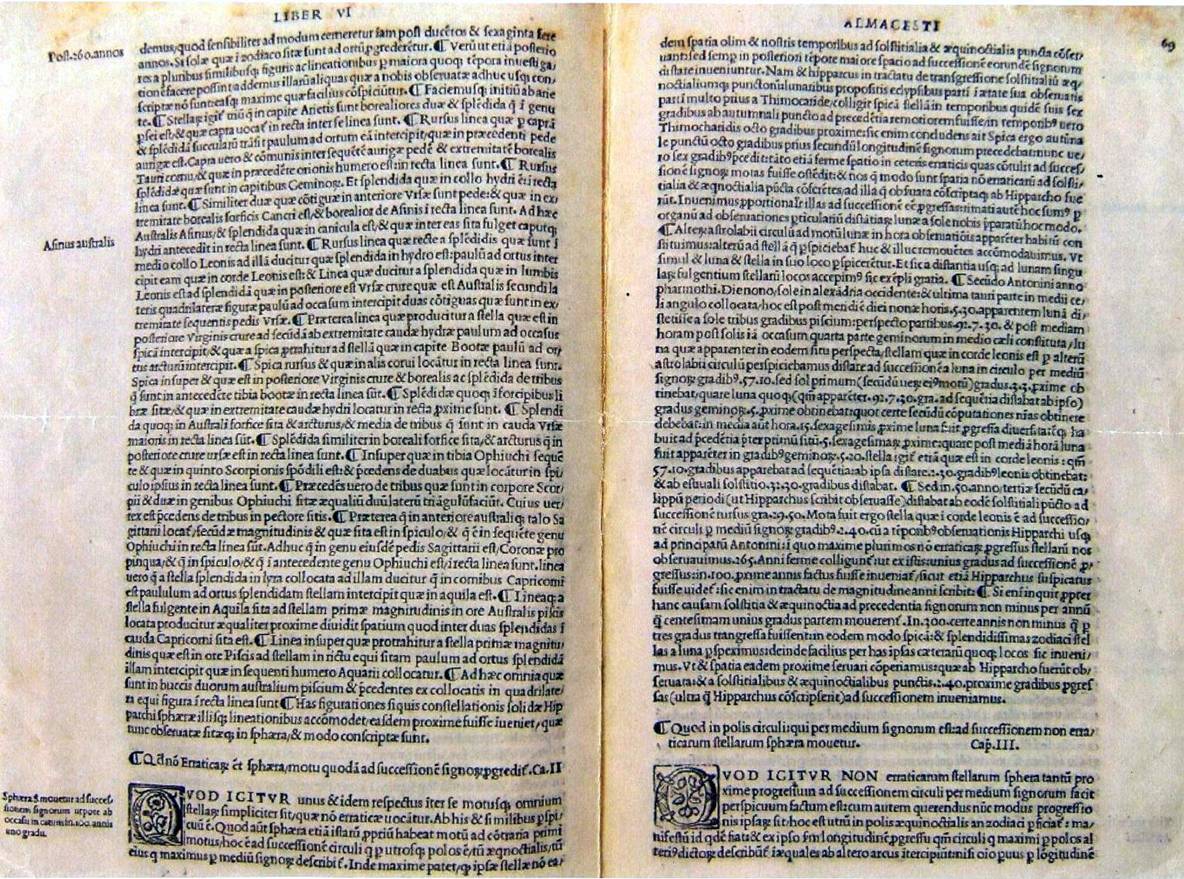
Picture 1
Ptolemaeus Claudius. Almagestum
seu magnae constructionis mathematicae opus…Venice, Giunta, 1528 (Genoa,
Italy, Berio Municipal Library, Preservation Division, classification: C.C.99).
4) Conclusions
The
reasonings stated above may are not proofs but surely clues that the aequinoctial
precession was known by the people of the Middle East since the IV millennium
b. C. at least, if not before. According with them, Hypparcus was not the
discoverer of aequinoctial precession but its first witness "in
writing" only. It may be that existed two different and indipendent
theories about the aequinoctial precession, as Masoretic and Greek Texts would
prove (Bianchi and Codebò 2005; Bianchi, Codebò, Veneziano 2005, 2009, c.s.1),
the one of Mesopotamic culture and the other of Greek culture.
It
maybe that the tropical configuration of the beginning of 4th
millennium b.C. has been handed down to posterity by the Sumerian civilization,
which developed in Mesopotamia just in that time.
Surely
the wrong amount of 1° per century of the aequinoctial precession speed cannot
be ascribed to Hypparcus but to Ptolemy, who showed himself an untrusting
witness.
5) Acknowledgements
I
wish to thank: Ettore Bianchi and Giuseppe Veneziano for their cultural
stimuli; Stefania Della Scala for her revision of my English text; Henry De
Santis for his support; Pier Paolo Ricci for his calculations; Alessandra
Marini for her advice about the Almagest latin text; Giovanna Marini and Serena
Massa for their advice about the Mithra’s religion; the Genoa State Library and
the Berio Municipal Library of Genoa with their staffs.
6) Bibliography
AA.VV.,
Encyclopaedia Juadaica, Keter Publishing House, Jerusalem, Israel
1971-1972.
AA.VV., Tutta la Scrittura è
ispirata da Dio e utile, Congregazione Crisitiana dei Testimoni di Geova,
Rome, Italy, 1991.
AA.VV., Pentateuco e Haftaroth,
Marietti, Tourin, Italy, 1976.
Alberti A., (a cura di…), Avesta,
UTET, Tourin, Italy 2004.
Amadasi Guzzo M. G. & Castellani
V., La "Coppa Foroughi": un atlante celeste del I millennio a. C.,
Giornale di Astronomia 31, n. 1, march 2005a, Italy.
Amadasi Guzzo M. G. & Castellani
V., La "Coppa Foroughi": un atlante celeste del I millennio a. C.,
Rivista Italiana di Archeoastronomia, IV, 2005b, Italy.
Bianchi E., Codebò M., Considerazioni
astronomiche sulle aspettative messianiche giudaico-cristiane, Atti del
VIII Seminario A.L.S.S.A. di Archeoastronomia, Genoa, Italy 2005a.
Bianchi E. Codebò M., Veneziano G., Ipotesi
astronomica sulla stella di Betlemme e sulle aspettative escatologiche coeve
nel mondo mediterraneo, Atti del V Convegno Nazionale S.I.A. di
Archeoastronomia, Astronomia antica e culturale e Astronomia storica, Milan,
Italy 2005b.
Bianchi E., Codebò M., Veneziano G., Tempo
della creazione e ciclo precessionale nella Bibbia, in: Atti del VII
Convegno Nazionale S.I.A., Rome, i.p., Italy.
Bianchi E., Codebò M., Veneziano G., Tempo
della creazione e ciclo precessionale nella Bibbia, in: Atti del X
Seminario A.L.S.S.A. di Archeoastronomia, Genoa, Italy 2009.
Codegoni A., Quell'imbroglione di
Claudio Tolomeo, Le Scienze, 436, dicembre 2004.
Eisenman R.H. and Wise M., I
manoscritti segreti di Qumran, ed.PiEmme, Casale Monferrato (AL), Italy
2006.
Elliger
K. & Rudolph W., Biblia Hebraica Stuttgartensia, Deutsche
Bibelgesellschaft Stuttgart, Stuttgart, Germany, 1967-1977.
Heiberg L. J., Syntaxis
Mathematica, B. G. Teubner, Lipsia, Germany 1903.
Meeus J., Astronomia con il
computer, Hoepli, Milano, Italy 1990.
Meeus
J., Astronomical Algorithms, Willmann-Bell Inc., Richmond, Virginia,
U.S.A. 2005
Neugebauer O., Le scienze esatte
nell'antichità, Feltrinelli, Milan, Italy 1974.
Nuova Diodati, La sacra Bibbia,
Edizione La Buona Novella, Brindisi, Italy, 1991.
Pettinato G. La scrittura celeste,
Mondadori, Milan, Italy 1998.
Ptolemaeus C., Alamgestum seu
magnae constructionis mathematicae opus..., Giunta, Venice, Italy 1528 (c/o
Berio Municipal Library of Genoa, Preservation Division, classification:
C.C.99).
Rahlfs
A., Septuaginta, Deutsche Bibelstiftung Stuttgart, Stuttgart, Germany,
1935.
Sacchi P., Apocrifi dell’Antico
Testamento, U.T.E.T., Tourin, Italy, 1981.
Taliaferro C. R., The Almagest,
23rd printing, Encyclopaedia Britannica Inc., U. K. 1980.
Usserius J., Annales Veteris
Testamentis, in folio, Oxoniensis, Italy 1722 (c/o Genoa State Library,
classification: 2.C.VIII.29; 1.B.VII.8)
Vattioni F., La bibbia di
Gerusalemme, Centro Editoriale Dehoniano, Bologna, Italy, 1977.
Weber
R., Vulgata, Württenbergische Bibelanstalt Stuttgart, Stuttgart,
Germany, 1969.